
Bring Something to the Table
The Quiet Truth About Relationships, Careers, and Growth

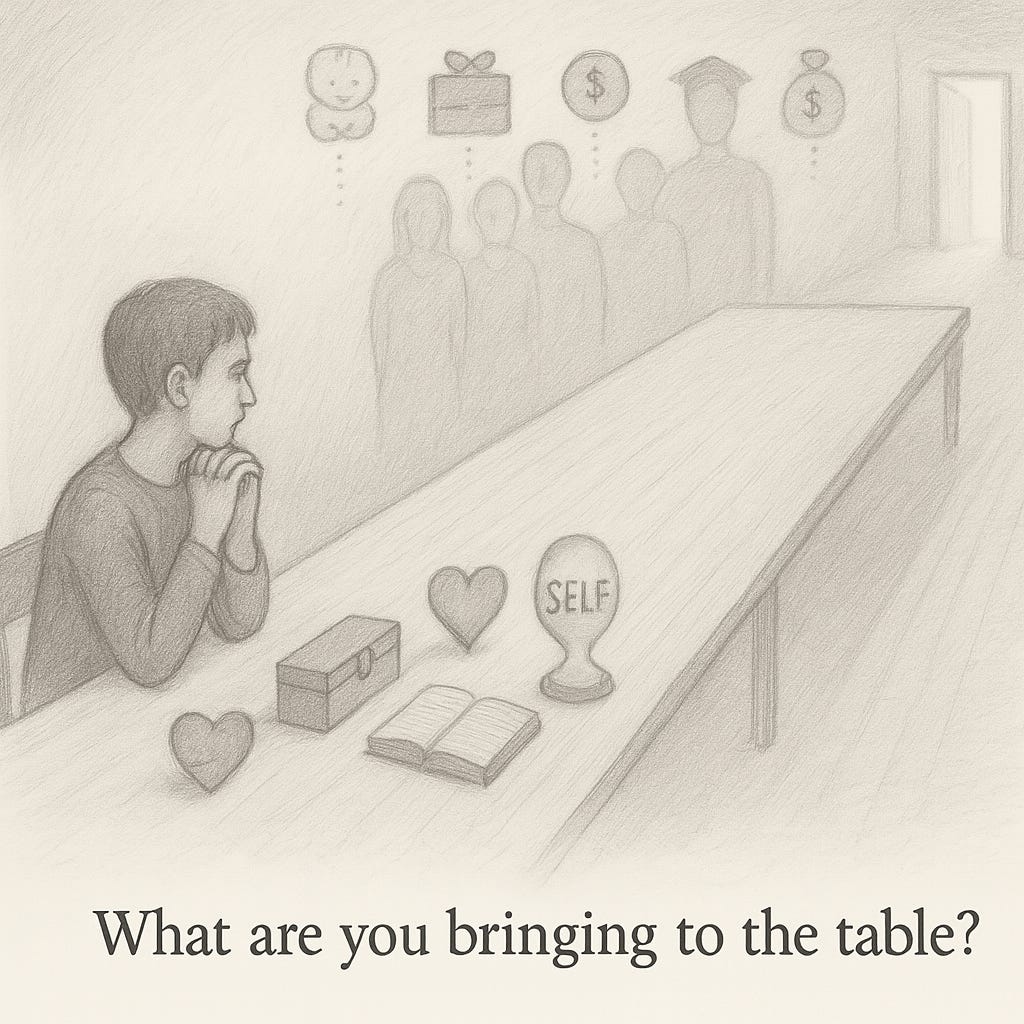
Welcome to the table of life.
There are two sides to this table, but you are the constant participant on one side. On the other side are people: starting with our parents, then our friends, employers, employees, spouses, and eventually our children if we choose to pass on our genes.
What’s happening at this table? We are negotiating. Yes, you heard right. Life is a negotiating table, and we can have anything we want brought to the table by the people on the other side. But there’s a catch: we need to bring something of value to ensure a fair exchange where everyone gets what they want.
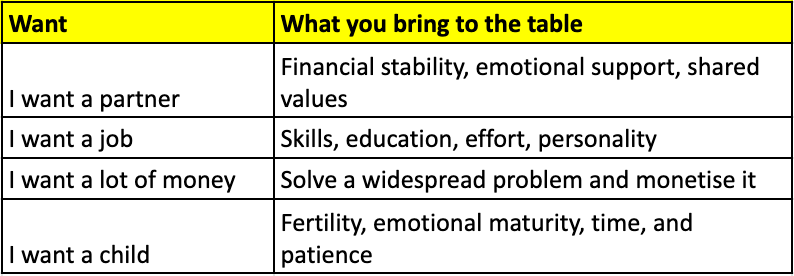
Here’s a fundamental truth. Behind every want is a person. It doesn’t matter what your goals are. Behind every goal, desire, and ambition is someone who has what you want and can give it to you. But they need a reason. That reason is what you must bring to the table.
Let’s look at some basic examples:
Where Things Go Wrong
All of this seems simple enough, but two main issues can arise:
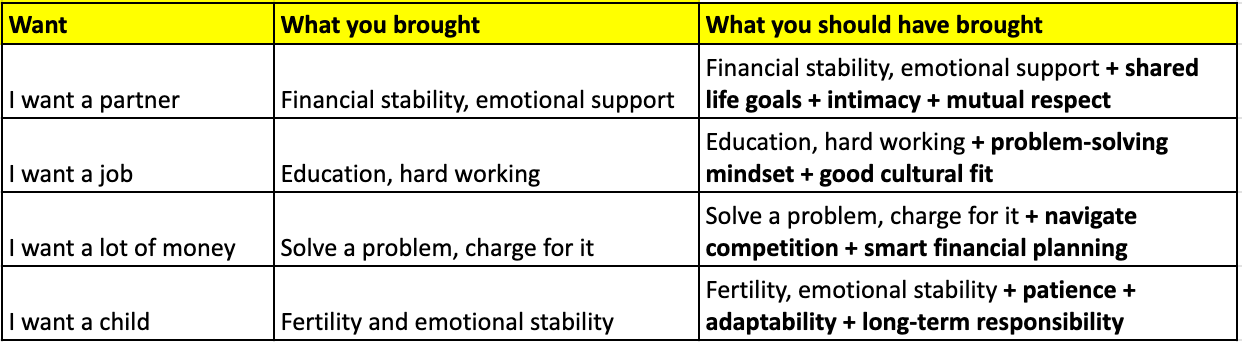
You bring the wrong thing to the table.
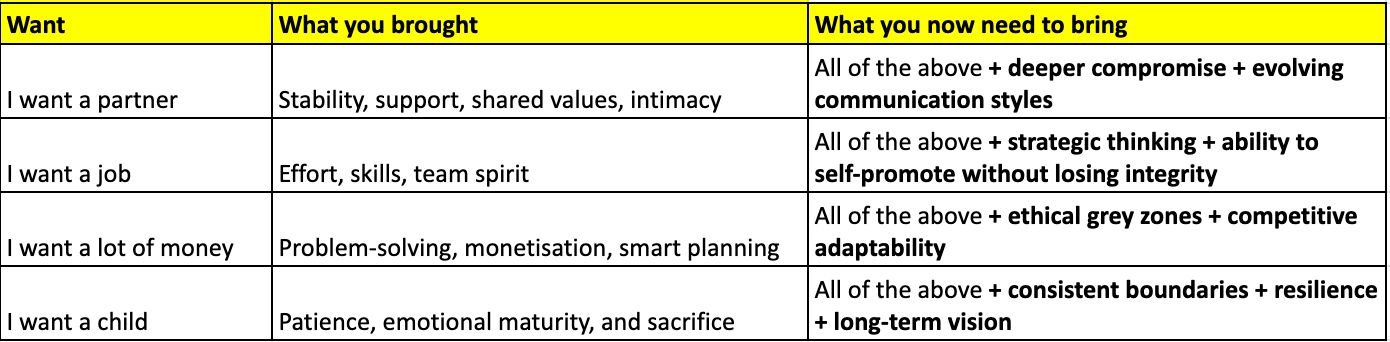
What you need to bring changes over time.
1. You Bring the Wrong Thing
This often happens because the people on the other side don’t explicitly tell you what they need. You have to discover it through observation, trial and error, and self-awareness. Sometimes, what’s unspoken is more important than what’s said. A partner may say they want financial security, but also expect emotional presence and quality time. An employer might value initiative more than qualifications.
Many of us are too impatient to figure out what’s truly required. We assume our first guess is good enough when in reality, it’s just one part of a much bigger ask.
Here’s what that mismatch might look like:
Sometimes, the mismatch occurs because our expectations haven’t evolved with our age or context.
For instance, someone aged 18 and someone aged 30 might both want a relationship. At 18, good looks, confidence, and charm might be enough. Financial security isn’t expected.
But at 30, trying to bring the same package won’t cut it. The person on the other side may be thinking long-term: Can you provide stability? Do you have goals? Will you contribute to a shared life?
Good looks and charm are no longer enough. The stakes are different, and so are the expectations.
This kind of mismatch is expressed everywhere: between friends, partners, colleagues, and even in therapy. We feel stuck in our jobs, disconnected from our partners, or disappointed with how things are going. Often, it’s not because we asked for the wrong thing. It’s because we didn’t bring the full version of what was required.
When someone says, “there was no spark,” despite someone bringing the “right” things on paper, they’re really saying: “You brought financial stability and kindness, but I also needed physical attraction and intellectual stimulation, which you didn’t provide.”
Why does this happen?
Psychologists suggest we often project – assuming others value what we value ourselves. Social learning research shows that cultural conditioning primes us to overemphasise traits our societies reward, such as achievement or financial provision. Identity also plays a role: we offer what feels most “us,” even when it is not what the situation requires.
2. What You Need to Bring Changes Over Time
Even when you bring the right things, life has a habit of shifting the goalposts.
What someone wants when they first sit down at the table may not be what they want later on. That’s the second trap.
Imagine you buy a pair of sneakers at a market. You agree to pay £50. But a week later, the seller returns and demands another £50 or asks you to return the shoes.
You’d say, “But that’s not what we agreed!”
And they reply, “Tough. Pay up or give them back.”
It’s an awkward situation. But it happens in life all the time. What worked before doesn’t work anymore, and the cost has gone up.
Here’s how that shift might look:
There is no easy way out of this conundrum. You’ve already made your bed, and now you have to lie in it – even if the blanket isn’t as warm as you hoped.
This is where compromise becomes essential. If we want to stay in the game, we must adapt. We need to accept that the rules change. And sometimes, yes, it means coughing up that extra £50 if we want to keep the trainers.
Let’s be honest: most people’s wants aren’t as simple as “I want a partner” or “I want a job.” They’re far more ambitious.
“I want a partner” becomes → “I want an intelligent, attractive, emotionally evolved partner who shares my worldview.”
“I want a job” becomes → “I want a six-figure role with meaning, flexibility, and growth.”
“I want a lot of money” becomes → “I want to be financially free, respected, and fulfilled before 40.”
“I want a child” becomes → “I want a thriving, well-rounded human who makes the world better.”
We are told to set specific goals – and we should. But the more specific your wants become, the more demanding the requirements are for what you must bring to the table.
Most people haven’t caught on to this.
I once asked a friend who had a long list of qualities she wanted in a partner what she was bringing to the table. Her answer? “I’m nurturing and will be a great mom.”
That’s a start, but there was a clear mismatch between the level of specificity in her wants and the generality of her offer. That gap is where frustration and unmet expectations often live.
The Table Has Expanded
In today’s world, the negotiation table has expanded. We’re no longer limited to whoever’s in our town. With the internet, global mobility, and endless access to information, everyone has options: better jobs, better partners, better opportunities.
And with more options comes more competition.
If you keep bringing the bare minimum to the table, someone else will walk in right after you, offering more. More value. More presence. More alignment.
That’s the new reality of the negotiation table of life.
Conclusion
Of course, not everything in life is a transaction. Some things like love, family, and kindness are given freely. But even those relationships thrive when we show up with intention, effort, and reciprocity.
At its heart, the idea of “bringing something to the table” is not about manipulating outcomes or treating people like business deals. It’s about understanding that value flows in both directions. Whether you’re seeking a partner, a promotion, or a place in the world, the exchange is always happening – quietly, subtly, and continuously.
What we offer says something about who we are. And what we ask for reflects what we believe we’re worth. The tension between those two things is where our growth lives.
So the challenge is not to be perfect, or to overperform, or to compete endlessly with others.
The real challenge is to be honest about what you want – and intentional about what you’re willing to give in return.
Because at every stage of life, the table will still be there.
The question is: What are you bringing with you when you pull up a chair?
Thank you for joining me on this journey. If you enjoyed this post, please consider hitting the like button and/or sharing it to help boost its visibility.
That’s me for now. Speak soon.
Hello Charles, thanks, real insightful, if you don’t mind, I have a question about getting honest with what you want and intentionality to show. What advice would you give for someone to get clear with figuring out what they want honest? As often you don’t know how to measure whether something is what you want or not? And showing intentionality.